


- Posts: 1080
- Thank you received: 106
3 Post Moderation Rule for New Boarders (25 Jan 2021)
New boarders will have their posts moderated - Don't worry if you cannot see your post immediately.
Why is "broadcast safe" still a thing?
28 Apr 2015 02:45 #63709
by Redifer
Why is "broadcast safe" still a thing? was created by Redifer
In this day in age I would think all of the issues of "broadcast safe" levels would be a thing of the past. Broadcast is now digital. Can digital broadcast not handle whites above a certain level? Did they not advance this when broadcast went digital? Why are we still obeying old NTSC laws? I'm sure some of you can answer this question for me, at least I hope you can.
Please Log in to join the conversation.
- ronny courtens
-

- Offline
- Moderator
-

Less
More
- Posts: 4455
- Thank you received: 962
28 Apr 2015 06:12 - 28 Apr 2015 19:44 #63713
by ronny courtens
Replied by ronny courtens on topic Why is "broadcast safe" still a thing?
Broadcast safe is still relevant for anything that is broadcasted. Not so much anymore because of the problems caused by illegal levels in the analog world (illegal blacks causing rolling images and illegal whites causing distorted audio), but to avoid ruining your picture quality due to automatic clipping of illegal blacks and whites.
Colors and levels that exceed bandwidth restrictions are clipped "hard" when they pass through a digital broadcast system. This means your picture quality will suffer a lot if your levels are too high or too low. You can compare this with over-exposed or under-exposed video from a handicam, not a very pleasant sight. Whites and blacks lose every detail. Furthermore text may become illegible and crushed blacks and whites may cause compression artifacts when your signal is converted to MPEG-2 TS for broadcasting.
So even if theoretically there is no real restriction anymore to work in broadcast safe, there still is a very valid practical reason for doing so: the quality of your video. That's why broadcasters will always reject programs that are not within broadcast safe limits.
The same retrictions apply to web delivery. Super whites and super blacks are the first things that cause artifacts when compressing for the web. If you only produce for the web and you don't care how your video looks on different screens you probably should not care about keeping your levels within normal boundaries. But if you do care about your picture quality, working within reasonable color and video levels will also make your video look much better. Again, that's purely a practical choice.
- Ronny
Last edit: 28 Apr 2015 19:44 by ronny courtens.
Please Log in to join the conversation.
- thefluentone
-

- Offline
- Senior Member
-

Less
More
- Posts: 68
- Thank you received: 5
28 Apr 2015 06:31 #63715
by thefluentone
Replied by thefluentone on topic Why is "broadcast safe" still a thing?
cool. I've wondered the same thing before.
Please Log in to join the conversation.
28 Apr 2015 07:37 - 28 Apr 2015 07:41 #63723
by BenB
Replied by BenB on topic Why is "broadcast safe" still a thing?
Similar for title safe. If you're web broadcasting, no technical need for it, but it can still make your presentation much nicer visually. Many technical restrictions end up simply being good design choices.
I've been teaching for a decade in Color classes, as per how Alexis Van Hurkman originally taught me, broadcast or film safe aren't only technical restrictions of the media format, but they also give you visually more appealing images regardless. Better contrast, more detail in the extremes, etc.
I've been teaching for a decade in Color classes, as per how Alexis Van Hurkman originally taught me, broadcast or film safe aren't only technical restrictions of the media format, but they also give you visually more appealing images regardless. Better contrast, more detail in the extremes, etc.
Last edit: 28 Apr 2015 07:41 by BenB.
Please Log in to join the conversation.
28 Apr 2015 08:56 #63733
by Deano
Replied by Deano on topic Why is "broadcast safe" still a thing?
Smiley face stamp for Ronny 
He nails it.
Bottom line is, the Network QC also like to see that you know what you are doing and that your content is within accepted industry norms... without them having to waste time in trying to make generic video material broadcast safe.
He nails it.
Bottom line is, the Network QC also like to see that you know what you are doing and that your content is within accepted industry norms... without them having to waste time in trying to make generic video material broadcast safe.
Please Log in to join the conversation.
- BrendanJTR
-
- Offline
- New Member
-

Less
More
- Posts: 5
- Thank you received: 1
28 Apr 2015 11:12 #63734
by BrendanJTR
Replied by BrendanJTR on topic Why is "broadcast safe" still a thing?
Great information Ronny, thanks.  Very helpful to my current work, as I'm required to heavily compress video for streaming.
Is it good/acceptable practice to crush the blacks to achieve stylistic results with a Broadcast Safe filter applied? Will this help keep image quality as good as can be when being compressed due to there, technically, not being super black and super white?
Very helpful to my current work, as I'm required to heavily compress video for streaming.Is it good/acceptable practice to crush the blacks to achieve stylistic results with a Broadcast Safe filter applied? Will this help keep image quality as good as can be when being compressed due to there, technically, not being super black and super white?
Please Log in to join the conversation.
28 Apr 2015 13:04 #63748
by Deano
Replied by Deano on topic Why is "broadcast safe" still a thing?
You can certainly crush blacks etc for a look aesthetic.
But be careful, as most broadcast safe filters crop items that fall outside those ranges. In most cases that should be ok. Certainly I find the blacks hold up better than blown out highlights - at least in my experience.
Whilst it's primarily photography related - I still think it's handy to become acquainted with the attached Ansel Adams zone system. Helps to reaffirm where various items should sit in terms of exposure.

I was taught early on that subtlety in terms of grading is usually the first and best way to go. I often get frustrated with some I work with when they take a beautiful HD or even 4k image, and then crush like mad, blow the highlights and add massive vignettes. It takes time for the human brain to decipher complex images. Let the full clarity sink in. IMHO.
But be careful, as most broadcast safe filters crop items that fall outside those ranges. In most cases that should be ok. Certainly I find the blacks hold up better than blown out highlights - at least in my experience.
Whilst it's primarily photography related - I still think it's handy to become acquainted with the attached Ansel Adams zone system. Helps to reaffirm where various items should sit in terms of exposure.
I was taught early on that subtlety in terms of grading is usually the first and best way to go. I often get frustrated with some I work with when they take a beautiful HD or even 4k image, and then crush like mad, blow the highlights and add massive vignettes. It takes time for the human brain to decipher complex images. Let the full clarity sink in. IMHO.
Please Log in to join the conversation.
- BrendanJTR
-
- Offline
- New Member
-
Less
More
- Posts: 5
- Thank you received: 1
28 Apr 2015 13:57 #63751
by BrendanJTR
Replied by BrendanJTR on topic Why is "broadcast safe" still a thing?
Thanks Deano,
I've encountered the Zones System before, but only in passing. I'll have to take a deeper look into it and how to employ it. I would agree with you about subtlety - I come from an audio background and personally try to work with subtle rather than extreme processing in that field also.
I've encountered the Zones System before, but only in passing. I'll have to take a deeper look into it and how to employ it. I would agree with you about subtlety - I come from an audio background and personally try to work with subtle rather than extreme processing in that field also.
Please Log in to join the conversation.
- MetalJesusRocks
-
- Offline
- Junior Member
-

Less
More
- Posts: 21
- Thank you received: 1
28 Apr 2015 19:25 #63767
by MetalJesusRocks
Replied by MetalJesusRocks on topic Why is "broadcast safe" still a thing?
Great question! I've been wondering this recently too.
Please Log in to join the conversation.
- Don Rumsey
-
- Offline
- Elite Member
-

Less
More
- Posts: 220
- Thank you received: 17
29 Apr 2015 04:08 #63777
by Don Rumsey
Replied by Don Rumsey on topic Why is "broadcast safe" still a thing?
I'm so glad this question has been asked. recently my new business partner and I were awarded a contract to produce some actual television commercials. So... It's a first for me and I'm wondering. Is it simply a matter of placing the broadcast filter over everything and presto like magicwe're ok? Or I'm thinking probably some tweaking here and there.
Please Log in to join the conversation.
29 Apr 2015 04:14 - 29 Apr 2015 04:16 #63778
by BenB
Replied by BenB on topic Why is "broadcast safe" still a thing?
Broadcast Safe filters "cut" things out. They can degrade your image seriously. It can get looking artificial.
Do proper color grading first. This keeps your images looking more natural, organic, realistic. You can pull more details from highlights and shadows, while pushing the envelope "appropreaetly".
Use the Broadcast Safe filter ONLY to clean up stray highlight data over 100 percent that you may have missed in the proper color grading pass.
Period.
Last edit: 29 Apr 2015 04:16 by BenB.
Please Log in to join the conversation.
29 Apr 2015 04:18 #63780
by Deano
Replied by Deano on topic Why is "broadcast safe" still a thing?
BenB is correct.
With 10.2 now - Yes, its a simple filter application - but I would ensure the filters are applied at the end of the image processing pipeline.
In FCP X - I would also ensure that you apply both CHROMA and LUMA filters as attached.
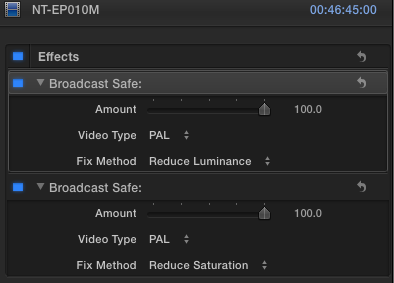
With 10.2 now - Yes, its a simple filter application - but I would ensure the filters are applied at the end of the image processing pipeline.
In FCP X - I would also ensure that you apply both CHROMA and LUMA filters as attached.
Please Log in to join the conversation.
29 Apr 2015 04:55 #63781
by BenB
Replied by BenB on topic Why is "broadcast safe" still a thing?
Only if necessary....
Please Log in to join the conversation.
- BrendanJTR
-
- Offline
- New Member
-
Less
More
- Posts: 5
- Thank you received: 1
29 Apr 2015 09:24 #63783
by BrendanJTR
And on that last point, in 10.2 you could now create a custom effects preset with two instances of the Broadcast Safe filter already set to luma and chroma for a 'full' broadcast safe filter.
Replied by BrendanJTR on topic Why is "broadcast safe" still a thing?
Deano wrote: BenB is correct.
With 10.2 now - Yes, its a simple filter application - but I would ensure the filters are applied at the end of the image processing pipeline.
In FCP X - I would also ensure that you apply both CHROMA and LUMA filters as attached.
And on that last point, in 10.2 you could now create a custom effects preset with two instances of the Broadcast Safe filter already set to luma and chroma for a 'full' broadcast safe filter.
Please Log in to join the conversation.
- BrendanJTR
-
- Offline
- New Member
-
Less
More
- Posts: 5
- Thank you received: 1
29 Apr 2015 09:29 - 29 Apr 2015 10:45 #63784
by BrendanJTR
Replied by BrendanJTR on topic Why is "broadcast safe" still a thing?
I've been reading more about the Zone system. Came across this handy approximate conversion chart:

Original site
Original site
Last edit: 29 Apr 2015 10:45 by BrendanJTR. Reason: Credit original site
Please Log in to join the conversation.
- DudeMeister
-

- Offline
- Senior Member
-
Less
More
- Posts: 47
- Thank you received: 2
01 Jun 2016 08:46 #77317
by DudeMeister
If there is nothing to be corrected (i.e. clamped), then the filter has zero effect, so "necessity" is technically irrelevant.
Replied by DudeMeister on topic Why is "broadcast safe" still a thing?
BenB wrote: Only if necessary....
If there is nothing to be corrected (i.e. clamped), then the filter has zero effect, so "necessity" is technically irrelevant.
Please Log in to join the conversation.
- Unfenswinger
-
- Offline
- Banned
-

Less
More
- Posts: 58
- Thank you received: 5
01 Jun 2016 10:24 #77322
by Unfenswinger
Your first question to the people commissioning your work is what actual Broadcast Specs you are delivering to. The broadcast specs will also include specs for the delivery of the audio too.
Check out the BBC technical delivery requirements here, dpp-assets.s3.amazonaws.com/wp-content/u...veryStandardsBBC.pdf
e.g.
RGB components must be between -5 % and 105% (-35 and 735mV) and
Luminance (Y) must be between -1% and 103% (-7mV and 721mV)
Stations and networks all have their own idea of what exactly their 'broadcast legal' levels are so it's not as easy as throwing those broadcast filters on and hoping for the best. Those filters can also make a mess of your image especially in the highly vibrant parts of the image which will get your work rejected on aesthetic grounds.
I have colleagues that do TV work periodically and they use an intermediary to quality check their work before delivery to the network to avoid embarrassing last minute compliance failures.
Replied by Unfenswinger on topic Why is "broadcast safe" still a thing?
Don Rumsey wrote: I'm so glad this question has been asked. recently my new business partner and I were awarded a contract to produce some actual television commercials. So... It's a first for me and I'm wondering. Is it simply a matter of placing the broadcast filter over everything and presto like magicwe're ok? Or I'm thinking probably some tweaking here and there.
Your first question to the people commissioning your work is what actual Broadcast Specs you are delivering to. The broadcast specs will also include specs for the delivery of the audio too.
Check out the BBC technical delivery requirements here, dpp-assets.s3.amazonaws.com/wp-content/u...veryStandardsBBC.pdf
e.g.
RGB components must be between -5 % and 105% (-35 and 735mV) and
Luminance (Y) must be between -1% and 103% (-7mV and 721mV)
Stations and networks all have their own idea of what exactly their 'broadcast legal' levels are so it's not as easy as throwing those broadcast filters on and hoping for the best. Those filters can also make a mess of your image especially in the highly vibrant parts of the image which will get your work rejected on aesthetic grounds.
I have colleagues that do TV work periodically and they use an intermediary to quality check their work before delivery to the network to avoid embarrassing last minute compliance failures.
Please Log in to join the conversation.
- Karsten Schlüter
-

- Offline
- Moderator
-
Less
More
- Posts: 3790
- Thank you received: 718
01 Jun 2016 15:41 #77336
by Karsten Schlüter
… but - making this thread instantly go ballistic :woohoo: - from that chart it is a small step to s-log, flat, curves, LUTs etc .. or, those - sorry, amateur speaking here - those pixelpeeper discussions about how diff. codecs handles diff. data (e.g. h264 cares less for shadows than midtones… yaddayadda … )
back2topic:
as many mentioned before, my simple translation is:
A Broadcast Safe is the visual equivilant to an audio-limiter.

Replied by Karsten Schlüter on topic Why is "broadcast safe" still a thing?
Deano wrote: …Whilst it's primarily photography related - I still think it's handy to become acquainted with the attached Ansel Adams zone system. Helps to reaffirm where various items should sit in terms of exposure.
….
… but - making this thread instantly go ballistic :woohoo: - from that chart it is a small step to s-log, flat, curves, LUTs etc .. or, those - sorry, amateur speaking here - those pixelpeeper discussions about how diff. codecs handles diff. data (e.g. h264 cares less for shadows than midtones… yaddayadda … )
back2topic:
as many mentioned before, my simple translation is:
A Broadcast Safe is the visual equivilant to an audio-limiter.
Please Log in to join the conversation.
01 Jun 2016 18:17 #77350
by bogiesan
Replied by bogiesan on topic Why is "broadcast safe" still a thing?
When I was a kid, balancing plumbicon studio cameras and mounting 2" quad tapes, we had waveforms and we had vectorscopes. Broadcast safe was a technical goal but it was also a legal concept. I learned how to use a light meter along with my scopes to achieve the best possible picture that was within legal restrictions.
My best tools remain the scopes.
My best tools remain the scopes.
Please Log in to join the conversation.
