


- Posts: 4455
- Thank you received: 962
3 Post Moderation Rule for New Boarders (25 Jan 2021)
New boarders will have their posts moderated - Don't worry if you cannot see your post immediately.
4K is weak, 6K is where it's at now
- ronny courtens
-

- Offline
- Moderator
-

Less
More
03 Sep 2014 15:10 #52161
by ronny courtens
Replied by ronny courtens on topic 4K is weak, 6K is where it's at now
The resolution of the human eye is about 1 arc minute :ohmy:
wolfcrow.com/blog/notes-by-dr-optoglass-...on-of-the-human-eye/
And here's a somewhat lighter approach to this question:
- Ronny
wolfcrow.com/blog/notes-by-dr-optoglass-...on-of-the-human-eye/
And here's a somewhat lighter approach to this question:
- Ronny
Please Log in to join the conversation.
- Karsten Schlüter
-

- Offline
- Moderator
-
Less
More
- Posts: 3790
- Thank you received: 718
03 Sep 2014 15:16 - 03 Sep 2014 15:32 #52162
by Karsten Schlüter
The eye is no emitter, but a receiver, so 'resolution' depends on distance; therefor measured in degrees.
Here's a rough schematic, I find impressive (do people sit THAT close to their new shiny 4k-Display?? :blink: )
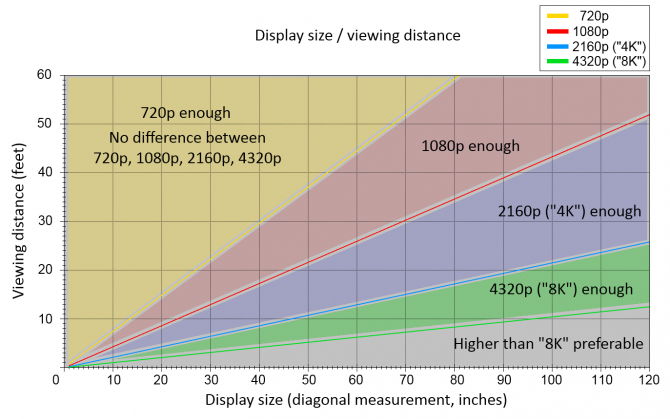
==edit==
oops, missed your reply, Ronny!
Your video is excellent (and it contains the same graphic as mine, he he), but teaches me two new astonishing things:
• the phrase wishy-washy = booked! (we have the same in German)
• my nose is constantly in view! Got to be 55y old, to realize that!!! :woohoo:
Replied by Karsten Schlüter on topic 4K is weak, 6K is where it's at now
pollux wrote: ... Side question. Does anyone know the resolution of a human eye?
The eye is no emitter, but a receiver, so 'resolution' depends on distance; therefor measured in degrees.
Here's a rough schematic, I find impressive (do people sit THAT close to their new shiny 4k-Display?? :blink: )
==edit==
oops, missed your reply, Ronny!
Your video is excellent (and it contains the same graphic as mine, he he), but teaches me two new astonishing things:
• the phrase wishy-washy = booked! (we have the same in German)
• my nose is constantly in view! Got to be 55y old, to realize that!!! :woohoo:
Last edit: 03 Sep 2014 15:32 by Karsten Schlüter.
Please Log in to join the conversation.


03 Sep 2014 15:34 - 03 Sep 2014 15:45 #52163
by BenB
All the charts and videos so far are folks "forcing" they eye/brain mechanics into a still image, limited frame size format. It can be done, but it is not the truth, and not actuate. (I had a whole semester on human perception mechanics.)
Remember, looking without moving your eyes is one way to quantify, but you're eyes never just stare in one direction, even when you're trying to do it.
Problem is, the eye doesn't see the world in pixels like a camera does, nor does it see in stills, like film does. Remember, in still photography and video/film, we are play tricks on the brain to make it think action is taking place, that really isn't.
The eye is measured in arcs per minute. There are many angles the eyes can collect data in over time, plus there are two, thus two different data sets (this does not correlate to how 3D film works), and then how the brain compiles and interprets the data.
So, even though folks try very hard to come up with a resolution for the human (or any animal) eye, it is very complex, and has no comparison to film or digital imagery.
I'll give this example. You're looking out over a meadow, shooting it with your video camera. Your camera takes a series of still images, each one with a limited amount of data. Your eyes in the mean time, are wondering all over the landscape, thus picking up more and more data over time, never seeing only one still image in the brain, ever. Thus, even if your eye, let's say, was 1080x720, that eye is moving constantly around and taking in data, thus your brain is assembling the continuous flow of landscape data which would amount to a resolution infinitely beyond a single 1080x720 still image. So there is no equivalent of "image resolution" to the human eye/brain. Since there is no start or end to the data stream, no frozen in time image, no fixed frame size, and the contestant data flow negates any limited pixel count as in video.
Apple to onions...
Replied by BenB on topic 4K is weak, 6K is where it's at now
pollux wrote: Side question. Does anyone know the resolution of a human eye?
All the charts and videos so far are folks "forcing" they eye/brain mechanics into a still image, limited frame size format. It can be done, but it is not the truth, and not actuate. (I had a whole semester on human perception mechanics.)
Remember, looking without moving your eyes is one way to quantify, but you're eyes never just stare in one direction, even when you're trying to do it.
Problem is, the eye doesn't see the world in pixels like a camera does, nor does it see in stills, like film does. Remember, in still photography and video/film, we are play tricks on the brain to make it think action is taking place, that really isn't.
The eye is measured in arcs per minute. There are many angles the eyes can collect data in over time, plus there are two, thus two different data sets (this does not correlate to how 3D film works), and then how the brain compiles and interprets the data.
So, even though folks try very hard to come up with a resolution for the human (or any animal) eye, it is very complex, and has no comparison to film or digital imagery.
I'll give this example. You're looking out over a meadow, shooting it with your video camera. Your camera takes a series of still images, each one with a limited amount of data. Your eyes in the mean time, are wondering all over the landscape, thus picking up more and more data over time, never seeing only one still image in the brain, ever. Thus, even if your eye, let's say, was 1080x720, that eye is moving constantly around and taking in data, thus your brain is assembling the continuous flow of landscape data which would amount to a resolution infinitely beyond a single 1080x720 still image. So there is no equivalent of "image resolution" to the human eye/brain. Since there is no start or end to the data stream, no frozen in time image, no fixed frame size, and the contestant data flow negates any limited pixel count as in video.
Apple to onions...
Last edit: 03 Sep 2014 15:45 by BenB.
Please Log in to join the conversation.


03 Sep 2014 20:08 #52168
by joema
There are many aspects to resolution, and various ways to express and measure this. Normally we think in terms of angular or linear resolution, but more loosely it could also refer to color resolution or even ability to resolve differences in brightness. Even dynamic range relates to resolution, if the goal is human eye equivalence. For video systems, temporal resolution or frame rate is also a factor. All those parameters affect the eye's perceptual ability to resolve differences in objects.
In terms of angular resolution a common figure is one arc minute or 1/60th of a degree. However this assumes a daylight pupil size of 3mm. A 6mm pupil will resolve twice as much, assuming the lighting conditions allowed that. A young person with keen eyesight might be able to resolve 0.4 arc min.
In terms of photo print resolution required to equal the naked eye's resolving power, this is roughly 720 dpi at a 1 ft. viewing distance. So an 8.5 x 11 inch print would require about 48 megapixels before the eye failed to perceive further increases in resolution. This obviously doesn't consider color.
The human eye has huge dynamic range -- a healthy young person can see in starlight (0.0001 lux), also on a bright sunlit beach (100,000 lux), a billion-to-one difference (30 stops). If the goal equal that in terms of video image capture or provide a video display which the eye cannot distinguish from reality, it's a high bar. That said, late-generation imagers are now approaching this dynamic range: www.sri.com/sites/default/files/brochure...cmos_datasheet_0.pdf
However in terms of pure resolution required in video playback before the human eye cannot resolve further improvements, we are essentially already there. It is around 4k resolution for typical large-screen viewing distances. Even a person with exceptional vision seated in mid-theater could not resolve beyond a 7k video image: www.red.com/learn/red-101/eyesight-4k-resolution-viewing
Even *below* 4k, there are very few people at normal household viewing distances that -- unprompted -- will notice the difference between 720p vs 1080p. Proof of this is all the HD material broadcast by ABC, Fox, ESPN, ESPN2, Disney, A&E and MLB Network is exclusively in 720p. 720p/60 has twice the temporal resolution of 1080p/30, but I'm not sure how many people notice that either.
Replied by joema on topic 4K is weak, 6K is where it's at now
pollux wrote: Side question. Does anyone know the resolution of a human eye?
There are many aspects to resolution, and various ways to express and measure this. Normally we think in terms of angular or linear resolution, but more loosely it could also refer to color resolution or even ability to resolve differences in brightness. Even dynamic range relates to resolution, if the goal is human eye equivalence. For video systems, temporal resolution or frame rate is also a factor. All those parameters affect the eye's perceptual ability to resolve differences in objects.
In terms of angular resolution a common figure is one arc minute or 1/60th of a degree. However this assumes a daylight pupil size of 3mm. A 6mm pupil will resolve twice as much, assuming the lighting conditions allowed that. A young person with keen eyesight might be able to resolve 0.4 arc min.
In terms of photo print resolution required to equal the naked eye's resolving power, this is roughly 720 dpi at a 1 ft. viewing distance. So an 8.5 x 11 inch print would require about 48 megapixels before the eye failed to perceive further increases in resolution. This obviously doesn't consider color.
The human eye has huge dynamic range -- a healthy young person can see in starlight (0.0001 lux), also on a bright sunlit beach (100,000 lux), a billion-to-one difference (30 stops). If the goal equal that in terms of video image capture or provide a video display which the eye cannot distinguish from reality, it's a high bar. That said, late-generation imagers are now approaching this dynamic range: www.sri.com/sites/default/files/brochure...cmos_datasheet_0.pdf
However in terms of pure resolution required in video playback before the human eye cannot resolve further improvements, we are essentially already there. It is around 4k resolution for typical large-screen viewing distances. Even a person with exceptional vision seated in mid-theater could not resolve beyond a 7k video image: www.red.com/learn/red-101/eyesight-4k-resolution-viewing
Even *below* 4k, there are very few people at normal household viewing distances that -- unprompted -- will notice the difference between 720p vs 1080p. Proof of this is all the HD material broadcast by ABC, Fox, ESPN, ESPN2, Disney, A&E and MLB Network is exclusively in 720p. 720p/60 has twice the temporal resolution of 1080p/30, but I'm not sure how many people notice that either.
Please Log in to join the conversation.
- Karsten Schlüter
-
- Offline
- Moderator
-
Less
More
- Posts: 3790
- Thank you received: 718
04 Sep 2014 06:09 #52175
by Karsten Schlüter
Replied by Karsten Schlüter on topic 4K is weak, 6K is where it's at now
That's what I really like about fcp.co:
This thread started as some fun, meanwhile delivers tons of valuable infos!
On other boards, any serious discussion ends lately after the first page of replies ...
meant as some 'meta info' ......... :silly:
This thread started as some fun, meanwhile delivers tons of valuable infos!
On other boards, any serious discussion ends lately after the first page of replies ...
meant as some 'meta info' ......... :silly:
Please Log in to join the conversation.
07 Sep 2014 14:06 #52319
by VidGreg
Replied by VidGreg on topic 4K is weak, 6K is where it's at now
Well slightly off topic,
Dell just came out with a 27" 5K Ulra Sharp Monitor. Cheap! Only $2500.00 USD
Will be interesting to see if Apple comes out with 4K monitors or iMacs.
Greg
Dell just came out with a 27" 5K Ulra Sharp Monitor. Cheap! Only $2500.00 USD
Will be interesting to see if Apple comes out with 4K monitors or iMacs.
Greg
Please Log in to join the conversation.
