


- Posts: 24
- Thank you received: 0
3 Post Moderation Rule for New Boarders (25 Jan 2021)
New boarders will have their posts moderated - Don't worry if you cannot see your post immediately.
FCP X Audio Meters - what scale are they at?
- adamschoales
-
 Topic Author
- Offline
- Junior Member
-

Less
More
14 Mar 2015 15:49 #61348
by adamschoales
FCP X Audio Meters - what scale are they at? was created by adamschoales
Quick question about the FCP X audio meters.
We're working on a project in the next week that we have to record our own sound for. We're using a zoom, and it looks like its at DBFS, where as FCP X seems to be something different.
It looks like what peaks at -6 DBFS on the zoom peaks at around -12 on whatever scale FCP X is recording at.
I want to ensure my levels are clean but not entirely sure what values to trust? Stuff sounds good when I bring it into final cut, and using a compressor I can bring those levels up to -6 on *its* scale, but I'd just like to know what I should be trusting to ensure we get the best levels.
Please Log in to join the conversation.

14 Mar 2015 20:52 #61358
by BenB
Replied by BenB on topic FCP X Audio Meters - what scale are they at?
DBFS is decibels relative to full scale, an adjusted scale. FCP legacy was DBFS, but there is not documentation I've ever seen that factually and finally states FCPX is that, or DB, just regular old decibels absolve. They are 2 different scales, and you can't just compare one to the other, since DBFS is an adjusted, relative scale, not an absolute.
Please Log in to join the conversation.
- adamschoales
-
Topic Author
- Offline
- Junior Member
-
Less
More
- Posts: 24
- Thank you received: 0
15 Mar 2015 19:37 #61372
by adamschoales
Replied by adamschoales on topic FCP X Audio Meters - what scale are they at?
I output some bars/tone from legacy FCP at various levels (-12, -6 and 0) and brought it into FCP X. They all seemed to show up at those exact points on the FCP X scale. So what that extra 6DB of headroom is I have no idea (though it certainly adds to the confusion).
But it would seem based on this limited, totally unscientific test that FCP X is *also* working in DBFS.
Still a bit odd that the zoom and FCP X had such differing levels though.
But it would seem based on this limited, totally unscientific test that FCP X is *also* working in DBFS.
Still a bit odd that the zoom and FCP X had such differing levels though.
Please Log in to join the conversation.

15 Mar 2015 20:12 - 15 Mar 2015 21:24 #61375
by Jimmyfinn
Replied by Jimmyfinn on topic FCP X Audio Meters - what scale are they at?
Is there anything in the Audio > Channel Configuration tab that may have affected the levels of the Zoom clips? Does X read them as -12 in both the browser and the timeline?
Last edit: 15 Mar 2015 21:24 by Jimmyfinn.
Please Log in to join the conversation.
16 Mar 2015 01:22 #61385
by BenB
Replied by BenB on topic FCP X Audio Meters - what scale are they at?
Now, audio is additive. If the Zoom recorded two channels, they'll sum together, and be more DB than if you go into FCPX and mute one of the channels. Not sure if that is is, but thought I'd mention that.
Please Log in to join the conversation.
- simon.a.billington
-
- Offline
- Elite Member
-

Less
More
- Posts: 179
- Thank you received: 10
17 Mar 2015 10:54 #61442
by simon.a.billington
Replied by simon.a.billington on topic FCP X Audio Meters - what scale are they at?
Possibly, the Pan Law could be messing you up a bit too.
I think that would account for only 3dB though, not sure about the compensated law however.
I think that would account for only 3dB though, not sure about the compensated law however.
Please Log in to join the conversation.
- adamschoales
-
Topic Author
- Offline
- Junior Member
-
Less
More
- Posts: 24
- Thank you received: 0
17 Mar 2015 12:03 #61446
by adamschoales
Replied by adamschoales on topic FCP X Audio Meters - what scale are they at?
Well the audio appears to be quieter so I'm not sure about that...
Please Log in to join the conversation.

17 Mar 2015 13:49 - 17 Mar 2015 18:42 #61451
by tpayton
Replied by tpayton on topic FCP X Audio Meters - what scale are they at?
From my tests the pan law in fcpx is lowering mono clips in stereo timelines -6db. The pan law [strike]doesn't [/strike]does appear to be in effect for surround timelines. Unfortunately it appears that when the mono signal is panned hard left or right we still see a -6db attenuation. I.e. It looks like a bug. Hopefully a fix comes soon and they will also use a more realistic -3db pan law.
Last edit: 17 Mar 2015 18:42 by tpayton. Reason: Fixed doesn't to does.
Please Log in to join the conversation.
17 Mar 2015 16:40 #61455
by BenB
Replied by BenB on topic FCP X Audio Meters - what scale are they at?
Pan Law is not a set number. It can range -1db to over -6db. Different apps/hardware do different things. I don't see it as a bug, just a choice Apple made.
Please Log in to join the conversation.
17 Mar 2015 18:40 #61461
by tpayton
Indeed I mistyped, I should have said that Apple chose a maximum -6db attenuation, where i think something like -3 would be more appropriate. However, the issue I'm referring to that in FCPX mono signals are lowered -6db in stereo timelines REGARDLESS of their being panned left, right or center. Sad to say the Pan Law is not implemented correctly in FCPX.
For example for a -12db mono placed in a stereo project in FCPX the following is true.
- When pan centered the -12db signal is now a -18db signal in both the left and right channels.
- When pan hard left the -12db signal is now -18db signal.
- When pan hard right the -12db signal is now -18db signal.
The last two items show that FCPX is the pan law is not in effect, only that mono signals are all lowered -6db.
What should happen with a -6db pan law.
- When pan centered the -12db signal is now a -18db signal in both the left and right channels.
- When pan hard left the -12db signal is now -12db signal.
- When pan hard right the -12db signal is now -12db signal.
Does that make sense?
The end result is that the loudest you can ever get a mono clip on a single timeline in FCPX is -6db unless you add an audio effect.
Replied by tpayton on topic FCP X Audio Meters - what scale are they at?
BenB wrote: Pan Law is not a set number. It can range -1db to over -6db. Different apps/hardware do different things. I don't see it as a bug, just a choice Apple made.
Indeed I mistyped, I should have said that Apple chose a maximum -6db attenuation, where i think something like -3 would be more appropriate. However, the issue I'm referring to that in FCPX mono signals are lowered -6db in stereo timelines REGARDLESS of their being panned left, right or center. Sad to say the Pan Law is not implemented correctly in FCPX.
For example for a -12db mono placed in a stereo project in FCPX the following is true.
- When pan centered the -12db signal is now a -18db signal in both the left and right channels.
- When pan hard left the -12db signal is now -18db signal.
- When pan hard right the -12db signal is now -18db signal.
The last two items show that FCPX is the pan law is not in effect, only that mono signals are all lowered -6db.
What should happen with a -6db pan law.
- When pan centered the -12db signal is now a -18db signal in both the left and right channels.
- When pan hard left the -12db signal is now -12db signal.
- When pan hard right the -12db signal is now -12db signal.
Does that make sense?
The end result is that the loudest you can ever get a mono clip on a single timeline in FCPX is -6db unless you add an audio effect.
Please Log in to join the conversation.
17 Mar 2015 18:52 #61463
by tpayton
Replied by tpayton on topic FCP X Audio Meters - what scale are they at?
BTW. The pan law implement is also not done correctly SoundTrack Pro. In Logic and FCP7 it is correctly implemented.
Please Log in to join the conversation.
17 Mar 2015 21:00 - 17 Mar 2015 21:02 #61473
by BenB
Replied by BenB on topic FCP X Audio Meters - what scale are they at?
Sorry, not how Pan Law works, it is not an absolute, and hardly any software implements it, because there's no way to predict that types of physical environment you'll be in. It is based on sound pressure in a physical environment.
In my studio, I'm not showing nearly the drastic difference in db you're getting with a test tone. 2-3 db max. But I'm in an acoustically treated room, too.
In my studio, I'm not showing nearly the drastic difference in db you're getting with a test tone. 2-3 db max. But I'm in an acoustically treated room, too.
Last edit: 17 Mar 2015 21:02 by BenB.
Please Log in to join the conversation.
17 Mar 2015 21:04 #61475
by tpayton
Replied by tpayton on topic FCP X Audio Meters - what scale are they at?
If you can show that Pan Law is working in FCPX that would be great!
Please Log in to join the conversation.
17 Mar 2015 21:10 #61478
by BenB
Replied by BenB on topic FCP X Audio Meters - what scale are they at?
I don't think attenuation for Pan Law is in any of the apps. I know very few that implement it. It would have to be attenuated to the physical environment of the room you're editing in, also.
Please Log in to join the conversation.
17 Mar 2015 21:25 #61482
by tpayton
Replied by tpayton on topic FCP X Audio Meters - what scale are they at?
As far as I understand it Pan Law should be implanted into any app that has stereo panning. It is in ProTools, Logic, Premier, FCP7, etc. Here is the setting in Logic 9:
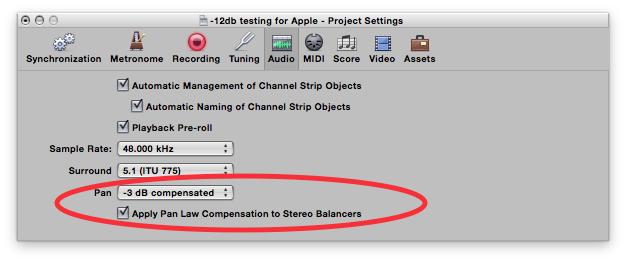
If you are a lynda.com subscriber you can see how it is implemented in ProTools here:
www.lynda.com/Pro-Tools-tutorials/Settin.../95249/102282-4.html
If you do the same test I mentioned above, you'll see that in Premier and FCP7 for example that a mono signal is not attenuated when panned hard left or right, but is when panned centered. As I noted above FCPX attenuates regardless of pan setting. Hence it doesn't actually implement Pan Law correctly.
To me the issue is not that Pan Law is implemented, but it is implemented incorrectly. I think generally a -6db single should in fact play back at -6db.
Please Log in to join the conversation.
17 Mar 2015 21:37 #61484
by tpayton
Replied by tpayton on topic FCP X Audio Meters - what scale are they at?
Here is the explanation from Logic users guide:
"Signals panned to the center position may sound louder than signals panned hard left or right. The Pan Law value determines the amount of volume reduction on signals that are panned to the center position."
"Signals panned to the center position may sound louder than signals panned hard left or right. The Pan Law value determines the amount of volume reduction on signals that are panned to the center position."
Please Log in to join the conversation.
17 Mar 2015 21:54 #61487
by BenB
Replied by BenB on topic FCP X Audio Meters - what scale are they at?
And if I were the mixing engineer, I'd turn all that junk off.
Please Log in to join the conversation.
- Tom Wolsky
-

- Offline
- Moderator
-

17 Mar 2015 21:57 #61488
by Tom Wolsky
Replied by Tom Wolsky on topic FCP X Audio Meters - what scale are they at?
I know absolutely nothing about this, but why do those two sentences sound contradictory to me. It may sound louder in the center when the volume is reduced.
Please Log in to join the conversation.
17 Mar 2015 22:02 #61489
by tpayton
Replied by tpayton on topic FCP X Audio Meters - what scale are they at?
Oh the Pan Law is nothing if it is not confusing.
Please Log in to join the conversation.
- ronny courtens
-

- Offline
- Moderator
-
Less
More
- Posts: 4455
- Thank you received: 962
17 Mar 2015 22:16 #61492
by ronny courtens
Replied by ronny courtens on topic FCP X Audio Meters - what scale are they at?
Oh the Pan Law is nothing if it is not confusing.
I will say Amen to that
- Ronny
I will say Amen to that
- Ronny
Please Log in to join the conversation.
