


- Posts: 1049
- Thank you received: 404
3 Post Moderation Rule for New Boarders (25 Jan 2021)
New boarders will have their posts moderated - Don't worry if you cannot see your post immediately.
FCPX v Adobe Premiere Pro v Avid Release History
- peteramwiggins
-
 Topic Author
- Offline
- Administrator
-

- The Administrator :)
Less
More
19 Feb 2015 16:35 - 19 Feb 2015 17:02 #60036
by peteramwiggins
Administrator
FCPX v Adobe Premiere Pro v Avid Release History was created by peteramwiggins
All,
An interesting list of dates from Jean-François McDonald.

An interesting list of dates from Jean-François McDonald.
Administrator
Last edit: 19 Feb 2015 17:02 by peteramwiggins.
Please Log in to join the conversation.

Less
More
- Posts: 971
- Thank you received: 46
19 Feb 2015 16:42 #60037
by MsJustine
Replied by MsJustine on topic FCPX v Adobe Premiere Pro v Avid Release History
To sum up the list, Apple leads and the twin A's follow like lost sheep...
Please Log in to join the conversation.

19 Feb 2015 17:02 #60040
by jfmcdo
Replied by jfmcdo on topic FCPX v Adobe Premiere Pro v Avid Release History
I did this using Wikipedia, so there might be some errors, but I thought I was an interesting perspective.
Please Log in to join the conversation.


19 Feb 2015 17:21 #60041
by FernKraft
Replied by FernKraft on topic FCPX v Adobe Premiere Pro v Avid Release History
That is interesting.
pardon my ignorance but, what is meant by the Green highlights in Adobe?
I don't see the relation between the highlights in Adobe and the highlights in FCPX and Avid.
What changed in adobe and avid at those highlights?
Thanks,
pardon my ignorance but, what is meant by the Green highlights in Adobe?
I don't see the relation between the highlights in Adobe and the highlights in FCPX and Avid.
What changed in adobe and avid at those highlights?
Thanks,
Please Log in to join the conversation.
19 Feb 2015 17:41 #60042
by jfmcdo
Replied by jfmcdo on topic FCPX v Adobe Premiere Pro v Avid Release History
Oh nothing meaningful it's just a full point release. Why do they change from 16.1 to 16.2 for example versus 16.1.2 is still a mystery to me. Sometimes a full point release means a feature release, sometimes it means sh**.
Please Log in to join the conversation.
19 Feb 2015 18:01 #60043
by FernKraft
Replied by FernKraft on topic FCPX v Adobe Premiere Pro v Avid Release History
fair enough.
thanks,
thanks,
Please Log in to join the conversation.
19 Feb 2015 18:16 #60045
by canelson
--
Matias Canelson
www.canelson.us
Replied by canelson on topic FCPX v Adobe Premiere Pro v Avid Release History
I would add the price of all the updates for Avid and subscriptions from Adobe for all those years compared to the $299 from FPCX since launch 
--
Matias Canelson
www.canelson.us
Please Log in to join the conversation.

19 Feb 2015 18:41 - 19 Feb 2015 18:41 #60046
by alex4D
Replied by alex4D on topic FCPX v Adobe Premiere Pro v Avid Release History
Some updates are bigger than others

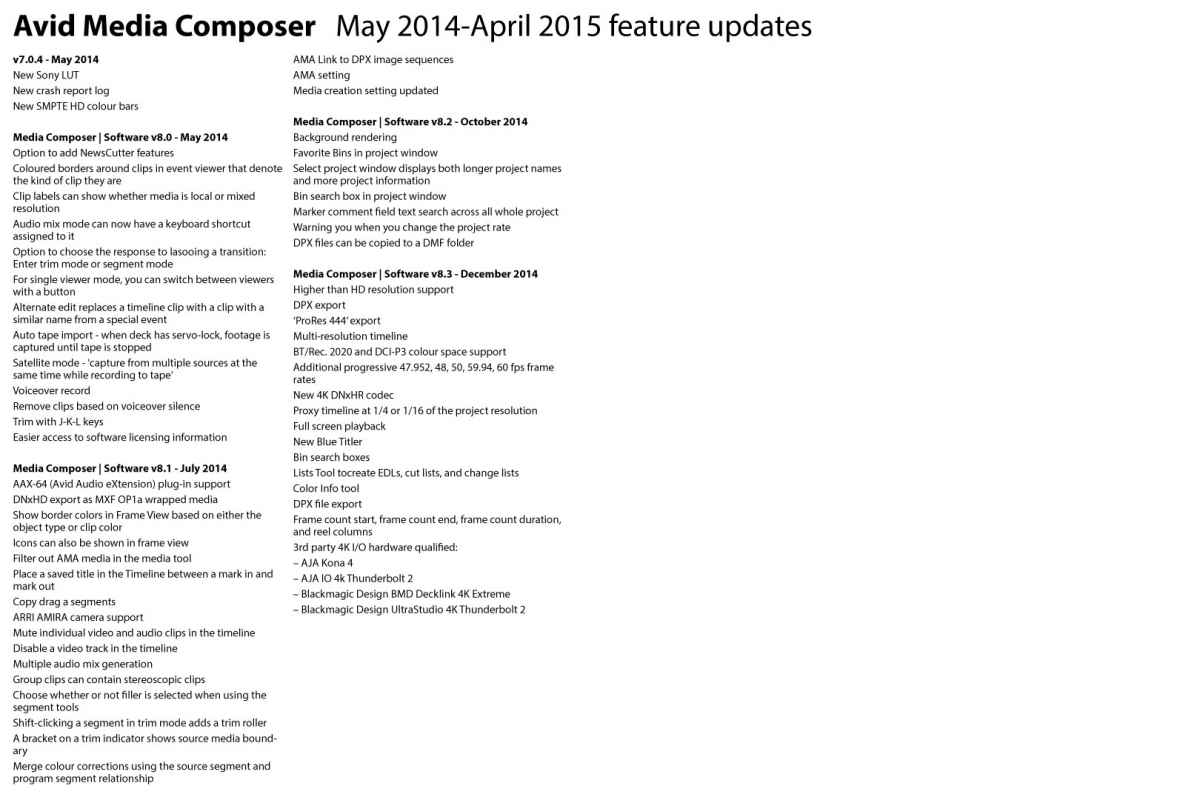
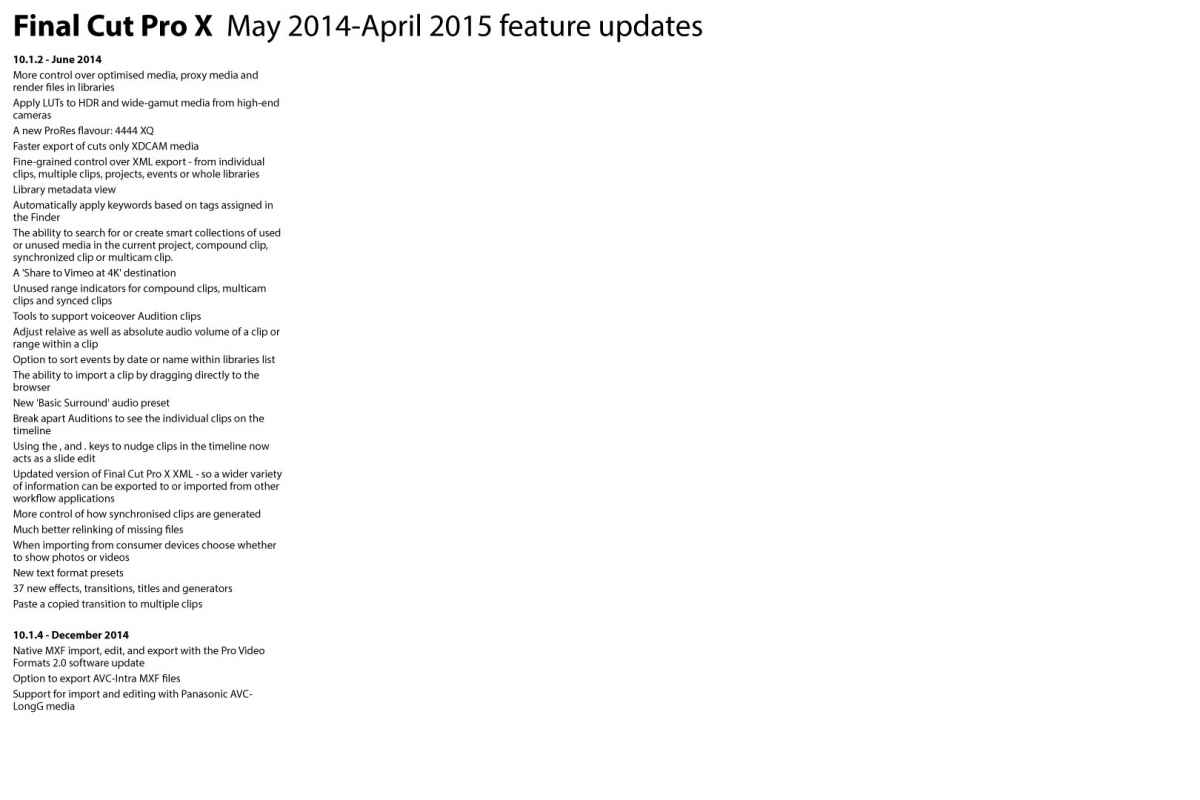
I'll be updating these lists in the coming months…
@Alex4D
I'll be updating these lists in the coming months…
@Alex4D
Last edit: 19 Feb 2015 18:41 by alex4D.
Please Log in to join the conversation.
19 Feb 2015 19:37 - 19 Feb 2015 19:43 #60049
by BenB
Replied by BenB on topic FCPX v Adobe Premiere Pro v Avid Release History
Yes, the monetary cost of owning each over that time, getting those updates, that would be really interesting, and I think much more meaningful.
FCPX = 15 updates
PPro = 12 updates
MC = 10 updates
Over 3 1/2 years, it is interesting. FCPX needed them the most to "catch up". PPro and MC needed them to fix stuff and gain functions that had been missing for years. I think specifically what was updated/added and how it was implemented will be the most telling. That's a comparison that would take time to compile and objectively document. But would be the second most significant piece of data, next to the cost of ownership over those 3 1/2 years. Or actually "rental" in PPro's case.
Last edit: 19 Feb 2015 19:43 by BenB.
Please Log in to join the conversation.
- JPM Editor
-

- Offline
- Premium Member
-

20 Feb 2015 17:09 - 20 Feb 2015 18:35 #60111
by JPM Editor
Jesús Pérez-Miranda
Cut People CEO & Founder
www.cutpeople.es
Replied by JPM Editor on topic FCPX v Adobe Premiere Pro v Avid Release History
Excellent topic, Peter!
Thanks to all the contributors!
I think it would be interesting to bring DaVinci Resolve into this comparison, at least since version 10.
I'm sure Blackmagic Design is going to keep developing it at a very fast pace until they have a fully featured NLE. I'm not a big fan of tracks anymore, but I wouldn't be surprised if DaVinci ends up becoming the best track-based NLE in the coming years. After all, they are learning from the best: Apple.
The way Blackmagic is mixing up features of both FCP legacy and FCPX may attract many editors unable to switch to trackless editing. So I guess Avid and Adobe have another big competitor in BMD. Apple, not so much.
Anyhow, I think we should stop considering the NLE market as a trialogue between the big three A's and include Blackmagic into the NLE Wars.
Jesús
@jesus_edits
Thanks to all the contributors!
I think it would be interesting to bring DaVinci Resolve into this comparison, at least since version 10.
I'm sure Blackmagic Design is going to keep developing it at a very fast pace until they have a fully featured NLE. I'm not a big fan of tracks anymore, but I wouldn't be surprised if DaVinci ends up becoming the best track-based NLE in the coming years. After all, they are learning from the best: Apple.
The way Blackmagic is mixing up features of both FCP legacy and FCPX may attract many editors unable to switch to trackless editing. So I guess Avid and Adobe have another big competitor in BMD. Apple, not so much.
Anyhow, I think we should stop considering the NLE market as a trialogue between the big three A's and include Blackmagic into the NLE Wars.
Jesús
@jesus_edits
Jesús Pérez-Miranda
Cut People CEO & Founder
www.cutpeople.es
Last edit: 20 Feb 2015 18:35 by JPM Editor.
Please Log in to join the conversation.
- JPM Editor
-
- Offline
- Premium Member
-
20 Feb 2015 18:15 #60117
by JPM Editor
Jesús Pérez-Miranda
Cut People CEO & Founder
www.cutpeople.es
Replied by JPM Editor on topic FCPX v Adobe Premiere Pro v Avid Release History
Just a few more thoughts:
www.macworld.com/article/1150431/ppcs5news.html
It came with 64-bit support and introduced the Mercury Playback Engine. I think this is one of the reasons why Apple had to push the launch of FCPX so soon.
A few more thoughts:
Jesús
@jesus_edits
Jean-François, I think the timeline should start a bit earlier than June 2011 and include Premiere Pro CS5, which was released in April, 2010:jfmcdo wrote: I did this using Wikipedia, so there might be some errors, but I thought I was an interesting perspective.
www.macworld.com/article/1150431/ppcs5news.html
It came with 64-bit support and introduced the Mercury Playback Engine. I think this is one of the reasons why Apple had to push the launch of FCPX so soon.
A few more thoughts:
- It seems that FCPX is the one with more updates between 2011-2015. But if we go by Alex Gollner's list of features, FCPX updates seem the less feature packed...
- Apple doesn't list all the new features that come with every version of FCPX in the official release notes, as Alex himself has noted in his blog many times. Instead, the competition is a bit more thorough in their official documentation.
- Also, for me it's not really a matter of quantity but quality:
Most features added by Avid and Adobe in the last years were all about mimicking FCP Legacy (at first), to attract Apple users disappointed with the FCPX launch. And later, they are incorporating some of the new ideas in FCPX (at least the ones they can fit in their traditional designs).
Instead, FCPX is refining the new paradigm and filling the holes... But they are not being influenced by the competition because they have a coherent design and a clear path. All this makes FCPX features more effective and better overall because of how well they interact with each other. To sum it up, I will paraphrase Spiderman's Uncle Ben: "with great design comes great functionality".
Jesús
@jesus_edits
Jesús Pérez-Miranda
Cut People CEO & Founder
www.cutpeople.es
Please Log in to join the conversation.
20 Feb 2015 18:33 #60120
by jfmcdo
Replied by jfmcdo on topic FCPX v Adobe Premiere Pro v Avid Release History
I agree, in the end it's just a list of dates, but it wasn't meant to compare the quality of the apps Jesus. If you want to know, at first I was curious to know if the time we're waiting now (number of days) for the next FCPX feature update was normal in comparision with past feature releases and in the industry in general. It's been what, more than 225 days now ? (Feature release, not bug fixes) And yes it looks like it's not uncommon. I must be just a bit impatient  Oh and why did I start it there ? FCPX release, everything had just changed in post
 Very arbitrary. As I keep mentionning, let's not read too much into it. It was not meant as an editorial. But great contribution from all, I'm always impressed to see how much people know their NLEs ! Thanks Alex and Jesus, your comments add a lot !
Oh and why did I start it there ? FCPX release, everything had just changed in post Very arbitrary. As I keep mentionning, let's not read too much into it. It was not meant as an editorial. But great contribution from all, I'm always impressed to see how much people know their NLEs ! Thanks Alex and Jesus, your comments add a lot ! Please Log in to join the conversation.
- JPM Editor
-
- Offline
- Premium Member
-
20 Feb 2015 18:48 #60124
by JPM Editor
Jesús Pérez-Miranda
Cut People CEO & Founder
www.cutpeople.es
Replied by JPM Editor on topic FCPX v Adobe Premiere Pro v Avid Release History
It's not so arbitrary, Jean-François!
Yes, everything changed in post after the FCPX launch. A few months after Adobe saw Apple's plans and how fast they were developing FCPX, they decided to go into a subscription based system (Creative Cloud). Avid followed along a few years later. It's the only way they can stay competitive.
But for me the key thing in all this is the 64-bit transition: Avid, Adobe and Apple had to rewrite the entire code of their NLEs. But only Apple decided to re-design Final Cut from the ground up. It was a lot more risky in the short term, but in my opinion, a wiser one in the long run.
About the days between feature releases... 225 days is not so much. Between 10.0.6 (October 23, 2012) and 10.1 (December 19, 2013), there was a very long wait of 428 days!
And 10.1 introduced the biggest changes to the application. So I guess, the more we wait, the better features we get!
Thanks again for bringing such an exciting topic!
Cheers,
Jesús
@jesus_edits
Yes, everything changed in post after the FCPX launch.
A few months after Adobe saw Apple's plans and how fast they were developing FCPX, they decided to go into a subscription based system (Creative Cloud). Avid followed along a few years later. It's the only way they can stay competitive.But for me the key thing in all this is the 64-bit transition: Avid, Adobe and Apple had to rewrite the entire code of their NLEs. But only Apple decided to re-design Final Cut from the ground up. It was a lot more risky in the short term, but in my opinion, a wiser one in the long run.
About the days between feature releases... 225 days is not so much. Between 10.0.6 (October 23, 2012) and 10.1 (December 19, 2013), there was a very long wait of 428 days!
And 10.1 introduced the biggest changes to the application. So I guess, the more we wait, the better features we get!
Thanks again for bringing such an exciting topic!
Cheers,
Jesús
@jesus_edits
Jesús Pérez-Miranda
Cut People CEO & Founder
www.cutpeople.es
Please Log in to join the conversation.
- JPM Editor
-
- Offline
- Premium Member
-
22 Feb 2015 12:19 #60221
by JPM Editor
Jesús Pérez-Miranda
Cut People CEO & Founder
www.cutpeople.es
Replied by JPM Editor on topic FCPX v Adobe Premiere Pro v Avid Release History
Here is an interesting article about the new flat look in the latest version of the Adobe Creative Cloud applications:
www.creativeimpatience.com/simplicity-overdone/
I've heard many FCPX users complaining that Premiere Pro got the flat 'Yosemite' look before FCPX. Yes, Adobe got there first (just like they did with the 64-bit transition -beating Apple & Avid- and the move to a subscription model -ahead of Avid-).
But in the long run, I think getting there first is not as important as getting it done right.
I don't care how long it takes Apple to redesign the user interface of FCPX (if they mean to do it). But I'm sure whatever they come up with, it's going to look a lot nicer than Premiere Pro's current UI.
Jesús
@jesus_edits
Jesús Pérez-Miranda
Cut People CEO & Founder
www.cutpeople.es
Please Log in to join the conversation.
- Oliver Peters
-

- Offline
- Platinum Member
-

Less
More
- Posts: 335
- Thank you received: 62
22 Feb 2015 14:14 #60224
by Oliver Peters
Replied by Oliver Peters on topic FCPX v Adobe Premiere Pro v Avid Release History
Really, the only part of this schedule that matters is 2014. Last year, all 3 companies released at about the same pace. With FCP X, nothing matters before 10.1, because that entire first iteration from 10.0 until 10.1 was completing the roadmap of things that were planned awhile back. Plus the change to Libraries, which was a bit of a step back and regroup move by Apple. Essentially correcting a path, without admitting they started out on the wrong foot.
Oliver
Oliver
Please Log in to join the conversation.
- ronny courtens
-

- Offline
- Moderator
-

Less
More
- Posts: 4455
- Thank you received: 962
22 Feb 2015 17:45 #60246
by ronny courtens
Replied by ronny courtens on topic FCPX v Adobe Premiere Pro v Avid Release History
I entirely agree. And it's always a bit risky comparing these NLEs in any way. They are fundamentally different and they get further developed in a completely different way.
- Ronny
- Ronny
Please Log in to join the conversation.
- JPM Editor
-
- Offline
- Premium Member
-
23 Feb 2015 10:40 #60265
by JPM Editor
Jesús Pérez-Miranda
Cut People CEO & Founder
www.cutpeople.es
Replied by JPM Editor on topic FCPX v Adobe Premiere Pro v Avid Release History
Interesting observations, Oliver and Ronny! Mr. Peters, I enjoy reading your excellent blog,
Digital Films
. It's been a great resource for years. I'm glad to have you here as a contributor!
I believe this is what pushed Adobe into the subscription model: it was the only way they could compete with Apple's aggressive development of FCPX. As the schedule shows, Premiere's updates become more frequent since CC7. The same applies to Avid since Media Composer 7, which almost overlaps with CC7 on time.
About the introduction of Libraries, I'm not sure that Apple was correcting a mistake with 10.1. The Libraries media management structure is very complex and it relies on the OS a lot. Maybe Apple released FCPX with the "provisional" Events/Projects model, because the Libraries model couldn't be release until Mavericks came out in October 2013. The fact that the first version of FCPX was named 10.0, certainly reinforces this theory.
The Libraries were probably planned since the beginning. But maybe they decided to launch FCPX prematurely with a basic media management structure because of the pressure coming from Premiere, which debuted a 64-bit playback engine as early as 2010, capable of decoding H.264 and thus eliminating the hassle of transcoding.
Jesús
@jesus_edits
I agree with you, Ronny: each NLE has its own development path to follow. But as Oliver pointed out, since 2014, all of them have picked the same development pace, because of the intense competition between them.ronny courtens wrote: it's always a bit risky comparing these NLEs in any way. They are fundamentally different and they get further developed in a completely different way.
But I disagree with Oliver on a few things. I think the early years of the schedule matter a whole lot. From 10.0 to 10.0.9, Apple really set the bar very high up, with frequent and fully packed updates in a way that we had never seen before in NLE history until then. And that's a very important fact in my opinion.Oliver Peters wrote: Really, the only part of this schedule that matters is 2014. Last year, all 3 companies released at about the same pace. With FCP X, nothing matters before 10.1, because that entire first iteration from 10.0 until 10.1 was completing the roadmap of things that were planned awhile back. Plus the change to Libraries, which was a bit of a step back and regroup move by Apple. Essentially correcting a path, without admitting they started out on the wrong foot.
I believe this is what pushed Adobe into the subscription model: it was the only way they could compete with Apple's aggressive development of FCPX. As the schedule shows, Premiere's updates become more frequent since CC7. The same applies to Avid since Media Composer 7, which almost overlaps with CC7 on time.
About the introduction of Libraries, I'm not sure that Apple was correcting a mistake with 10.1. The Libraries media management structure is very complex and it relies on the OS a lot. Maybe Apple released FCPX with the "provisional" Events/Projects model, because the Libraries model couldn't be release until Mavericks came out in October 2013. The fact that the first version of FCPX was named 10.0, certainly reinforces this theory.
The Libraries were probably planned since the beginning. But maybe they decided to launch FCPX prematurely with a basic media management structure because of the pressure coming from Premiere, which debuted a 64-bit playback engine as early as 2010, capable of decoding H.264 and thus eliminating the hassle of transcoding.
Jesús
@jesus_edits
Jesús Pérez-Miranda
Cut People CEO & Founder
www.cutpeople.es
Please Log in to join the conversation.
- ronny courtens
-
- Offline
- Moderator
-
Less
More
- Posts: 4455
- Thank you received: 962
23 Feb 2015 12:26 #60273
by ronny courtens
Replied by ronny courtens on topic FCPX v Adobe Premiere Pro v Avid Release History
I think you would be surprised about how little Apple cares about the competition with other NLEs. While others are just building on the same old foundation, the really interesting part of the development path for FCP X has only started. I suggest we have this conversation again by the end of this year
- Ronny
- Ronny
Please Log in to join the conversation.
23 Feb 2015 12:49 #60280
by BenB
Replied by BenB on topic FCPX v Adobe Premiere Pro v Avid Release History
It has been told to me by someone at Apple, way back when FCPX first launched, that it was indeed released prematurely, and dictated by upper management, and some folks got in trouble for it. The Libraries model includes the older Event/Project model, and they're part of the same system. There's no evidence that Apple "change course", and I would state, based on what I've been told by folks there, they have never wavered off their original course.
Ronny has it right, Apple is developing new tools, in new implementations, with new software technologies. The rest are updating coding that is over a decade old. Apples to onions...
Personally, I'll add this. When I give a class or a seminar, and someone brings up NLE comparisons, I cut them off with this statement, and refuse to let anyone get into that debate. "All NLEs are fine, they can all cut digital video equally well, and which anyone uses is personal choice, and none of my or anyone else damned business. I am here to teach and support Final Cut Pro X for those who've made that choice. If you want to learn the others, see me afterwards, I have plenty of friends certified to teach those applications, and will be more than happy to give you the referral. Back to Final Cut..."
Please Log in to join the conversation.
- Oliver Peters
-
- Offline
- Platinum Member
-
Less
More
- Posts: 335
- Thank you received: 62
23 Feb 2015 21:15 #60310
by Oliver Peters
Thanks for the kind words. The reason I discount these early updates is because FCP X development started at least a couple of years prior to the release and it's my belief that most of these features were already on the roadmap. It's simply that they couldn't be included at the time of the initial release, because the weren't "ready for prime time". So for example, adding multicam has often been characterized as Apple responding to the customer feedback. From what I know about software development, that's a pure fantasy. It simply takes longer than that, so I feel this was always planned, just not ready yet. For all intents and purposes, I consider the first year after FCP X was first released was really just a public beta period, though obviously unofficial.
I don't know. It's certainly possible that this could have been tied to some sort of OS framework, but its introduction caused users a large change in their workflow and how they understood the software to operate. The shift to libraries also removed some of the functionality that was in projects before. I simply find it hard to believe that something that causes such a drastic change in how an application works was something that was planned all along. If it was, then that's incredibly bad planning for an application so early in its development path. I prefer to believe that Apple was in fact responding to customer push-back, but I could be wrong.
I don't think you can place much stock in version numbers. After all the "10" in this number is product branding and not a true version number. Technically 10.0 was version 1.0 and 10.1 is version 2.0 if you compare it to other software numbering conventions.
Oliver
Replied by Oliver Peters on topic FCPX v Adobe Premiere Pro v Avid Release History
JPM Editor wrote: But I disagree with Oliver on a few things. I think the early years of the schedule matter a whole lot. From 10.0 to 10.0.9, Apple really set the bar very high up, with frequent and fully packed updates in a way that we had never seen before in NLE history until then. And that's a very important fact in my opinion.
Thanks for the kind words. The reason I discount these early updates is because FCP X development started at least a couple of years prior to the release and it's my belief that most of these features were already on the roadmap. It's simply that they couldn't be included at the time of the initial release, because the weren't "ready for prime time". So for example, adding multicam has often been characterized as Apple responding to the customer feedback. From what I know about software development, that's a pure fantasy. It simply takes longer than that, so I feel this was always planned, just not ready yet. For all intents and purposes, I consider the first year after FCP X was first released was really just a public beta period, though obviously unofficial.
JPM Editor wrote: About the introduction of Libraries, I'm not sure that Apple was correcting a mistake with 10.1
I don't know. It's certainly possible that this could have been tied to some sort of OS framework, but its introduction caused users a large change in their workflow and how they understood the software to operate. The shift to libraries also removed some of the functionality that was in projects before. I simply find it hard to believe that something that causes such a drastic change in how an application works was something that was planned all along. If it was, then that's incredibly bad planning for an application so early in its development path. I prefer to believe that Apple was in fact responding to customer push-back, but I could be wrong.
JPM Editor wrote: The fact that the first version of FCPX was named 10.0, certainly reinforces this theory.
I don't think you can place much stock in version numbers. After all the "10" in this number is product branding and not a true version number. Technically 10.0 was version 1.0 and 10.1 is version 2.0 if you compare it to other software numbering conventions.
Oliver
Please Log in to join the conversation.
